
Mortgage Payoff Calculator With Extra Payments
See how extra monthly payments change your mortgage payoff date and total interest. Try an extra amount each month to pay off your home loan early and pay less interest.
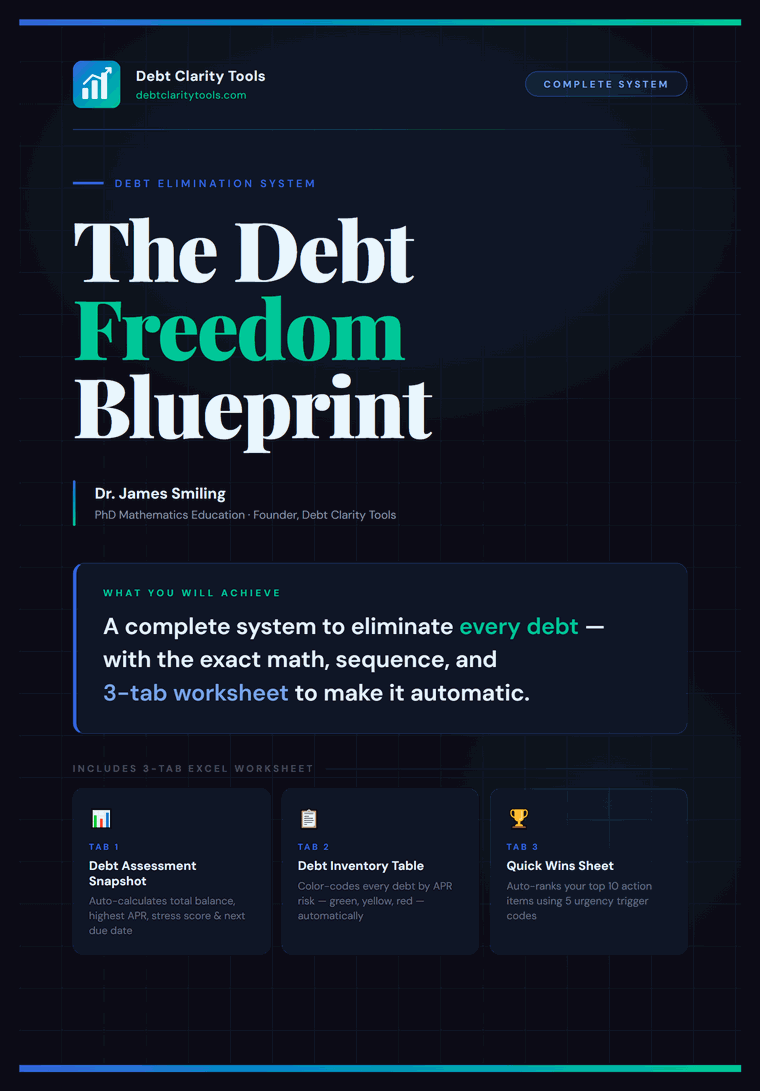
Watching Finance with Fred? Each episode has a free worksheet on its episode page, and the free Debt Freedom Blueprint (a PDF guide plus Excel workbook) arrives in your inbox when you ask for it.
Your Mortgage
Enter your mortgage balance, APR, term, and an optional extra monthly payment.
Assumes monthly compounding and one payment per month.
Graph
Your balance dropping to zero, month by month
Month-by-month payoff schedule
Desktop shows a table. Mobile shows stacked rows.
| Month | Starting balance | Interest | Payment | Ending balance |
|---|
Scroll to see all months.
Results
Your payoff summary updates after calculation.
Considering combining balances to simplify payments? Try the Debt Consolidation Calculator.

Dr. James Frederick Smiling, PhD, Mathematics Education
These calculators were built by a university mathematics education professor who teaches statistics and financial literacy at the college level. He holds a PhD in Mathematics Education and has spent his career turning hard math into something everyday people can actually use.
As a husband and father of six, he has personally navigated student loans, credit card debt, and the rising cost of running a household, so these tools are built to respect both the math and the real-life pressure behind it. No hype, no pressure, just the clear numbers most debt advice leaves out.
- ✓ PhD in Mathematics Education
- ✓ Teaches college statistics & financial literacy
- ✓ Standard amortization math, the method lenders use
- ✓ 100% free, we never store your numbers
How this calculator works: interest compounds monthly on your balance; your APR and payment stay fixed unless you change them; no new charges are added; results are estimates for planning, not financial advice.
Want to see what a little extra each month really does to a 30-year loan? Watch this:
What people are saying
Real, unprompted reviews, verified on Trustpilot.
"I wanted to see how fast I could pay off one of my credit cards. In about a minute it showed me exactly how many payments I had left and the date it would be paid off. It motivated me to put even more toward the card. So simple a third-grader could use it."
Dwight C.
"After searching for sites to help me understand and control my debt, this turned out to be the best one out there. It's simple to use and answers a lot of questions for free, and if you want a deeper plan, the guides are priced fairly. I'd gladly recommend it to anyone carrying real debt."
Richard B.
"The tools on this site helped me understand my personal finances better. I'd recommend them to anyone."
Alex J.
Your Mortgage Payoff Results, How Much Sooner You Finish
Even a small extra payment each month can move your mortgage payoff date more than most people expect.
-
🏠 Extra payments reduce your balance first
Based on your inputs, an extra payment goes toward your mortgage balance. A lower balance means less interest can build up over the life of the loan. -
📉 Interest savings grow over time
Your results show how paying extra earlier can cut the total interest you pay. Paying the same amount every month matters more than the size of any single extra payment. -
⏱️ Why your payoff date moves
Example: On a $300,000 mortgage at 6.8% over 30 years, adding $200 a month pays it off about 7 years sooner because you reduce the balance faster. Your estimated payoff time and totals are shown above.
If you want a clear next step based on these results…
Put every debt on one page, free
The Debt Freedom Blueprint is a free PDF guide and Excel workbook. List each debt once and see what your minimums cost you every month and which debt to hit first.
Get the free Blueprint →For educational planning only, not financial advice.
How Extra Mortgage Payments Change Your Payoff Timeline
mortgage with $200/mo extra
On a $300,000 mortgage at 6.8% over 30 years, adding an extra $200 a month pays the loan off about 7 years sooner and saves around $111,000 in interest. The reason is simple: every dollar of balance you remove early stops adding interest for the rest of the loan.
Extra Payments Should Go to Principal
On a mortgage, an extra payment helps most when it goes straight to principal, the balance your interest is figured on. A lower balance means less interest each month, and that effect grows over the years. Ask your servicer how to apply extra money to principal: many will hold it as your next payment unless you tell them "apply to principal," so the instruction matters.
On a standard mortgage, an extra payment reduces your balance. A lower balance means less interest can build up going forward, which can shorten how long you pay.
Why Timing Matters
$300k 6.8% loan is interest
A mortgage is front-loaded with interest. On a $300,000 loan at 6.8%, the first monthly payment is about $1,956, and roughly $1,700 of that is interest. That is why an extra payment made early saves far more than the same amount paid years later, you are cutting the balance that would have added the most interest.
Paying extra earlier usually has a bigger effect because it lowers the balance sooner. A smaller balance early in the schedule often leads to less total interest over the life of the mortgage.
Important Details to Check with Your Lender
Before you start extra payments, check three things with your mortgage servicer: your loan has no prepayment penalty, extra money is applied to principal (not held as your next payment), and the payment posts in the same billing cycle. Prepayment penalties are rare on modern mortgages, but a quick call confirms it and removes the guesswork.
Some mortgages have rules that affect extra payments, such as prepayment penalties, how payments are applied, or a need to say "apply to principal." Confirm how your servicer handles extra payments before you rely on a plan.
Go deeper: Biweekly vs monthly payments, How extra payments cut years off a loan, Does paying off a loan early hurt credit?, Extra payments on a personal loan
FAQ
How much does an extra $200 a month save on a $300,000 mortgage at 6.8%?
On a $300,000 mortgage at 6.8% over 30 years, the monthly payment for principal and interest is about $1,956. Adding $200 a month, paying about $2,156, moves your payoff from 30 years to roughly 23 years. That is about 7 years sooner, and it saves around $111,000 in interest. The savings are this large because each early payment lowers the balance that interest is figured on, so less interest builds up for the rest of the loan. Run your own balance, rate, and term in the calculator above to see your exact numbers.
Does my extra mortgage payment go to principal or interest?
On a standard mortgage, your regular payment first covers the interest owed since your last payment, and the rest lowers the balance. A mortgage is front-loaded with interest: on a $300,000 loan at 6.8%, about $1,700 of your first $1,956 payment is interest. An extra payment marked "principal only" skips the interest step and goes straight to lowering your balance, which is why it has such a big effect on your payoff date. It only works this way if you tell your servicer to apply the extra money to principal, otherwise some servicers hold it as your next payment instead.
How do I make sure my servicer applies extra payments to principal?
The most reliable way is to make a separate payment, not combined with your regular payment, and mark it "principal only," either in a check memo or with your servicer's online principal-only option. Then check your next statement to confirm the balance dropped by the full extra amount, not just by the normal schedule. If the statement shows your extra money was applied to next month's payment instead of principal, call your servicer and ask them to correct it. This is a common default that quietly costs homeowners money.
Is it better to pay a little extra every month or one big payment a year?
Paying extra every month usually saves a bit more than one lump sum a year, because you lower the balance earlier, so less interest builds up in the months in between. The difference is small, though. On a $300,000 mortgage at 6.8%, one extra full payment a year (about $163 a month set aside) pays the loan off about 6 years sooner and saves roughly $96,000. If your money is lumpy, a bonus, a tax refund, or commission, a once-a-year extra payment is still very effective. Pick the schedule you can actually keep.
Will paying off my mortgage early cost me a penalty?
For most homeowners, no. Prepayment penalties are rare on modern mortgages, and federal rules limit them on many home loans, so extra payments usually cost you nothing beyond the payment itself. Still, it is worth confirming before you start: check your loan documents for a "prepayment" section, or call your servicer and ask directly. If your loan has no penalty, you are free to pay extra toward principal whenever you like and shorten your payoff. This is about your payoff math, it is not advice to refinance or change your loan.
How much does an extra $100 a month save on my mortgage?
On a $300,000 mortgage at 6.8% over 30 years, adding $100 a month to the roughly $1,956 payment moves your payoff from 30 years to about 26 years, around 4 years sooner, and saves roughly $66,000 in interest. The bigger your balance and rate, the more each extra dollar does, because there is more interest to remove. Even a small, steady extra amount adds up over the life of a home loan. Use the calculator above with your own balance, rate, and term to see your exact month and interest savings.
Is it better to pay off my mortgage early or invest the money instead?
There is no single right answer, so weigh a few things. Paying down a 6.8% mortgage early is like earning a guaranteed 6.8% return with no risk, while investing the same money might earn more over time but can also lose value. Before paying extra on the mortgage, most people first build an emergency fund and capture any full employer 401(k) match, since those come first. After that it comes down to math and how much a paid-off home is worth to you personally. This is general information, not financial advice, run your own numbers in the calculator above to see the guaranteed interest savings from paying early.
Do biweekly mortgage payments really pay off your loan faster?
Yes, and here is why. Biweekly means you pay half your monthly amount every two weeks, which adds up to 26 half-payments, 13 full payments, a year instead of 12, so you make one extra payment every year without really feeling it. On a $300,000 mortgage at 6.8%, that one extra payment a year pays the loan off about 6 years sooner and saves roughly $96,164 in interest. You can get the exact same result by adding one-twelfth of your payment to each monthly payment. Just confirm your servicer applies the extra straight to principal and does not charge a biweekly setup fee.
How can I pay off a 30-year mortgage in 15 years?
To cut a 30-year mortgage in half, you raise your monthly payment enough to reach a 15-year payoff. On a $300,000 loan at 6.8%, the 30-year payment is about $1,956, and a 15-year payoff needs about $2,663, roughly $707 more each month. In return you save about $224,730 in interest, because the balance falls far faster. If the full amount is too much, even a smaller steady extra payment still moves your payoff date up. Enter your balance, rate, and target date in the calculator above to see the exact extra payment you need.
100% free · no card
Every debt in one place
This calculator answers one question about one debt. The Debt Freedom Blueprint puts all of them on a single page: what you owe in total, what the minimums are costing you every month, and which debt to hit first.
- A PDF guide that shows you the order to pay in
- An Excel workbook that does the arithmetic for you
- Auto-ranked quick wins from the numbers you type
Built by a mathematics education professor. Unsubscribe any time.
Four more decisions about this loan
This calculator answers one question. Your mortgage will ask four more: can you recast it, when can PMI come off, what will escrow do next year, and should retirement money go near the house at all. The Payoff Planner Pro answers all four on your own numbers and writes the letter to your servicer.
See the Payoff Planner Pro →One payment of $97. Nothing renews. 30 days to change your mind.