On $20,000 across four debts at $735 a month, the avalanche costs $4,468.87 in interest and the snowball $4,900.30. Avalanche saves $431.43. Snowball clears your first debt six months sooner.
Put your own balances, APRs and minimum payments in below. The calculator runs both methods on your real numbers and gives you the payoff order, the payoff month, and the total interest for each one.
Last updated August 26, 2026. Written and checked by Dr. James Frederick Smiling, PhD, Mathematics Education.
Your Debts
Balances, APRs, minimums, and optional extra monthly amount.
Debt name
Balance ($)
APR (%)
Minimum ($)
Assumptions: interest compounds monthly, payments are made monthly, no new charges are added, and minimum payments stay constant.
Results Dashboard
Payoff time, interest, payoff date, and payoff order for each method.
Debt Snowball
Smallest balance first
Payoff time
-
Total interest
-
Payoff date
-
Payoff priority (extra goes here first)
Debt Avalanche
Highest APR first
Payoff time
-
Total interest
-
Payoff date
-
Payoff priority (extra goes here first)
Quick takeaway
-
Tip: Add 2-4 debts. Enter balances, APR, minimums, and your extra monthly amount.
Month-by-Month Payoff Schedules
Totals across all debts per month (no sideways scrolling on mobile).
Snowball payoff table
Month
Starting balance
Interest
Payment
Ending balance
Avalanche payoff table
Starting balance
Interest
Payment
Ending balance
Snowball, payment per debt, month by month
Based on your extra payment, here's exactly what goes toward each debt each month under the snowball order. Tap a debt to expand.
Avalanche, payment per debt, month by month
Based on your extra payment, here's exactly what goes toward each debt each month under the avalanche order. Tap a debt to expand.
✓ Check your inbox, your plan is on the way.
Who built this & how it's calculated
Dr. James Frederick Smiling, PhD, Mathematics Education
These calculators were built by a university mathematics education professor who teaches statistics and financial literacy at the college level. He holds a PhD in Mathematics Education and has spent his career turning hard math into something everyday people can actually use.
As a husband and father of six, he has personally navigated student loans, credit card debt, and the rising cost of running a household, so these tools respect both the math and the real-life pressure behind it. No hype, no pressure, just the clear numbers most debt advice leaves out.
✓ PhD in Mathematics Education
✓ Teaches college statistics & financial literacy
✓ Standard amortization math, the method lenders use
✓ 100% free, we never store your numbers
How this calculator works: interest compounds monthly on your balance; your rate and payment stay fixed unless you change them; no new charges are added; results are estimates for planning, not financial advice.
"I wanted to see how fast I could pay off one of my credit cards. In about a minute it showed me exactly how many payments I had left and the date it would be paid off. It motivated me to put even more toward the card. So simple a third-grader could use it."
Dwight C.
★★★★★
"After searching for sites to help me understand and control my debt, this turned out to be the best one out there. It's simple to use and answers a lot of questions for free, and if you want a deeper plan, the guides are priced fairly. I'd gladly recommend it to anyone carrying real debt."
Richard B.
★★★★★
"The tools on this site helped me understand my personal finances better. I'd recommend them to anyone."
Alex J.
How Fast Does Your Balance Actually Fall?
Your balance dropping to zero, month by month
Snowball
Avalanche
Can't decide between the two? Try the Stair Stepper Calculator, the snowball + avalanche hybrid that groups your debts by balance and hits the highest rate in each group first. Or see how extra payments change your timeline with the Loan Extra Payment Calculator.
What Do Your Snowball vs Avalanche Results Actually Mean?
Your results show two numbers that pull against each other: total interest, which the avalanche usually wins, and the date of your first cleared debt, which the snowball usually wins.
⚖️ Two strategies, two outcomes Using your inputs, the calculator shows which payoff method finishes sooner and which minimizes total interest.
🧠 Motivation vs math tradeoff Your results highlight the tradeoff: Snowball may deliver faster early wins, while Avalanche typically reduces total interest. The better choice is the one you're most likely to stick with.
📊 How strategy choice changes results Micro-example: With two debts, Snowball may eliminate a smaller balance first, while Avalanche targets the higher rate. Your exact payoff months and interest totals are shown above.
If you want a clear next step based on these results…
Put every debt on one page, free
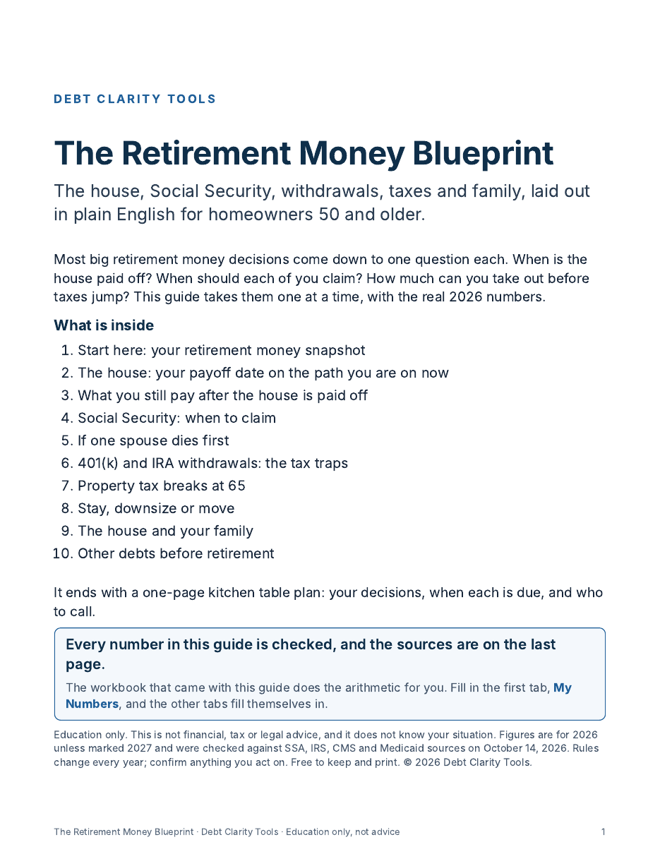
The Retirement Money Blueprint is a free 12-page guide and Excel workbook. List each debt once and see what the minimums cost you every month and which one to hit first, plus the month your mortgage ends.
For educational planning only, not financial advice.
Which Saves More Money, the Debt Snowball or the Debt Avalanche?
The avalanche saves more money in almost every case. On the $20,000 example below it saves $431.43 and finishes a month sooner, but it makes you wait six extra months for a win.
22.15%
avg APR on cards charged interest (Fed G.19, Q2 2026)
Key Stat
The Federal Reserve G.19 Consumer Credit release puts the average rate on credit card accounts assessed interest at 22.15% for Q2 2026, up from 21.52% in Q1, with the all-accounts average at 20.94%. Neither the snowball nor the avalanche changes your rate. They only change the order you kill balances in, and that order is worth $431.43 on the four-debt example on this page.
Pay the minimum on every debt, then send every spare dollar to the smallest balance, whatever its rate. When that debt hits zero, roll its old minimum into the next smallest. The ordering rule is balance size.
Definition: the debt avalanche
Pay the minimum on every debt, then send every spare dollar to the highest APR, whatever its balance. When that debt hits zero, roll its old minimum into the next highest rate. The ordering rule is interest rate.
What Does the Difference Look Like in Real Dollars?
Here are four debts totaling $20,000 with $535 in minimums, run three ways. Same balances, same rates, same $735 a month. Only the order changes.
Approach
Monthly
Months to zero
Total interest
First debt gone
Minimums only
$535
56
$9,898.56
Month 37
Snowball, $200 extra
$735
34
$4,900.30
Month 6
Avalanche, $200 extra
$735
33
$4,468.87
Month 12
Debts used: personal loan $1,400 at 10.99% (min $45), store card $2,800 at 29.99% (min $85), Visa $6,200 at 24.49% (min $155), car loan $9,600 at 7.99% (min $250). Month-by-month amortisation, interest compounded monthly, no new charges, freed minimums rolled forward. Computed and re-verified against the calculator engine on August 27, 2026.
Read the last two rows together. The avalanche is $431.43 cheaper and one month faster. The snowball gets you to a zero balance in month 6 instead of month 12. That is the whole argument, and it is smaller than most people expect: $431.43 across nearly three years is about $13 a month.
Here is the part that gets people. If you pick the avalanche because it is mathematically correct, then quit in month 9 because nothing has been paid off yet and it feels like nothing is happening, you did not save $431.43. You saved nothing. Gal and McShane found exactly that in the data: in their study of real debt accounts, closing an account predicted eventually clearing the whole balance, and the dollar size of the account closed did not (Gal and McShane, Journal of Marketing Research, 2012).
How Do I Actually Run One of These Methods?
Five steps. It takes about twenty minutes with your statements in front of you, and you only have to do it once.
List every debt with its current balance, its APR, and its required minimum payment. Pull all three off the statement, not from memory.
Add up the minimums. That is the floor you have to hit every month no matter which method you pick.
Decide the extra. Look at what is actually left after the bills and pick a number you can send every month without fail. In the example above it is $200.
Pick the order. Smallest balance first is the snowball. Highest APR first is the avalanche. Write the order down and do not revisit it.
Roll the freed payment forward. When a debt hits zero, its old minimum goes on top of the extra and moves to the next debt in your order. Skip this step and the whole method stops working.
What Is the Debt Snowball Method?
The snowball pays your smallest balance first regardless of rate, so you clear an account early and the freed minimum rolls onto the next debt.
Quick Answer
The snowball method pays off your smallest balance first, regardless of interest rate. Each eliminated account frees up its minimum payment to roll into the next debt, creating a "snowball" of growing payments. It optimizes for behavior change and psychological momentum, not math. For many people, staying motivated is the harder variable to solve.
Reviewed by Dr. James Frederick Smiling, PhD
The Snowball method prioritizes paying off the smallest balance first.
It is designed to build momentum through quick wins, which can help people stay consistent over time.
What Is the Debt Avalanche Method?
The avalanche pays your highest APR first regardless of balance. It is the cheaper path on paper, and the slower one to feel like progress.
Quick Answer
The avalanche method targets your highest-interest debt first, paying minimums on everything else. It's mathematically optimal, you pay less total interest and become debt-free faster. The trade-off: early wins are smaller since high-rate balances are often large, which can make it harder to stay on track when progress feels slow in the first few months.
Reviewed by Dr. James Frederick Smiling, PhD
The Avalanche method prioritizes paying off the highest interest rate first.
It is designed to minimize total interest cost and is typically the most efficient approach mathematically.
What Does This Calculator Assume?
Interest compounds monthly, your total monthly payment stays flat, freed minimums roll forward, and you add no new charges to any account.
Quick Answer
This calculator assumes you make the same total monthly payment each month and that minimum payments on untargeted accounts stay fixed. It doesn't account for new charges, rate changes, or balance transfer fees. For the most accurate payoff timeline, use your actual current balances, minimum payments, and APRs from each account statement.
Reviewed by Dr. James Frederick Smiling, PhD
This calculator assumes consistent monthly payments and no new debt.
Real-life results can change if balances increase, rates change, or payments vary.
Use it to compare strategies and choose the approach you can realistically maintain.
What Do People Ask Most About the Snowball and Avalanche Methods?
The nine questions below are the ones readers send most often, answered with the same amortisation the calculator on this page runs.
Does this calculator include extra monthly payments on top of minimums?
Yes. Enter an extra monthly amount and the calculator adds it on top of every required minimum, then sends the whole extra to the current target debt: the smallest balance under the snowball, the highest APR under the avalanche. When a debt clears, its old minimum rolls into the extra and moves to the next debt. On the four-debt example on this page, $200 a month of extra cuts the payoff from 56 months to 33 and the interest from $9,898.56 to $4,468.87.
Which method saves more money, the debt snowball or the debt avalanche?
The avalanche saves more in almost every case. On four debts totaling $20,000 paid at $735 a month, the avalanche costs $4,468.87 in interest and the snowball costs $4,900.30, a gap of $431.43, and the avalanche finishes one month sooner. On a smaller two-debt case, $4,500 at 26% and $1,800 at 14% with $350 a month, the gap is $254.74 and one month. The gap widens when one balance carries a much higher rate than the rest, and it shrinks toward nothing when your rates are close together.
Which method is better if I feel overwhelmed by debt?
Then take the snowball. On the four-debt example on this page it hands you a cleared account in month 6 instead of month 12, and for a lot of people that matters more than the $431.43 it costs. Gal and McShane studied real accounts at a debt settlement firm and found that closing an account predicted eventually clearing the whole balance, while the dollar size of the account closed did not (Journal of Marketing Research, 2012). A cheaper plan you quit in month 9 saves you nothing at all.
How much more interest does the snowball cost versus the avalanche?
On the four-debt example on this page it costs $431.43 spread over 34 months, which is about $13 a month. The size of the gap tracks the spread between your highest and lowest APR. When every rate sits within three or four points of the others, the two methods often finish in the same month and the difference lands under $50. When one card sits at 29.99% and everything else is under 12%, the gap gets much larger, because that card keeps compounding while the snowball works through smaller accounts first.
Can I combine the debt snowball and avalanche methods?
Yes, and it often works better than either one alone. The usual version is to clear one or two small balances snowball style for the early win, then switch to strict avalanche order once the account count is down and the pressure has eased. The rule that has to survive any hybrid is one target at a time. Splitting your extra across three debts at once dilutes both methods and clears nothing quickly. The Stair Stepper Calculator on this site runs that hybrid for you if you want to see it in numbers.
How do I decide which debt to put extra payments toward first?
Send it all to one debt. Which one depends on what you need more. If you have a balance under $1,000 you can wipe out in two or three months, take it, because a cleared account frees up a minimum payment and gives you something real to point at. If your highest rate is also one of your bigger balances, go there first, because it will keep compounding for years otherwise. The one rule that does not bend is that all the extra goes to a single debt at a time, never split across several.
How long does it realistically take to pay off $15,000 using the snowball method?
About 38 months at $500 a month, made up of $350 in minimums plus $150 extra, across a realistic four-debt spread. That number assumes you roll each freed minimum into the next debt, which is the whole mechanic of the method. Raise the extra from $150 to $250 and the same $15,000 clears in 31 months instead of 38, and the interest drops from $4,106.95 to $3,107.94, a saving of $999.01 for $100 more a month.
What happens if my smallest debt is also my highest rate?
Then the two methods are the same plan and the choice does not matter at all. The three debts loaded into this calculator by default show it: a $1,200 store card at 29.99%, a $4,500 Visa at 24.99% and a $7,800 car loan at 8.5%. Smallest balance and highest rate are the same account, so with $150 extra both methods finish in 30 months at $2,599.36 in interest, identical to the cent. Check your own list before you spend a week agonising over the choice, because more people are in this position than realise it.
What is the debt avalanche method, and when does it beat the snowball?
The debt avalanche method means paying the minimum on every debt, then putting all your extra money toward the debt with the highest interest rate first. When that one is gone, you roll its payment onto the next-highest rate, and so on. The avalanche beats the debt snowball whenever your highest-rate debts are not also your smallest, because attacking the biggest interest rate first saves the most money and time. The trade-off is motivation: if your highest-rate debt is large, it can take a while to see your first win, which is why some people still prefer the snowball. Enter your debts above to see exactly how much the avalanche saves versus the snowball for your numbers.
100% free · no card
Every debt in one place
This calculator answers one question about one debt. The Retirement Money
Blueprint puts all of them on a single page: what you owe in total, what the
minimums are costing you every month, and which debt to hit first.
A PDF guide that shows you the order to pay in
An Excel workbook that does the arithmetic for you