Adding $200 a month to a $20,000 loan at 7.14% APR ends it in 38 months instead of 60 and saves $1,470.24 in interest. Extra money goes straight to principal.
Every dollar you remove from principal stops earning the lender interest for the rest of the loan, which is why the effect compounds. Put your own balance, rate, term and extra amount in below. The calculator returns your payoff month, your total interest, your total paid, and a full month-by-month schedule you can scroll.
Last updated August 28, 2026. Written and checked by Dr. James Frederick Smiling, PhD, Mathematics Education.
What Numbers Do I Need to Run This?
Four numbers off your statement: the balance you still owe, the APR, the years left on the term, and any extra amount you can add each month.
Assumes monthly compounding and one payment per month.
What Does the Payoff Curve Show?
Your remaining balance plotted month by month. The line starts shallow because early payments are mostly interest, then steepens as principal takes over.
Month-by-month payoff schedule
Desktop shows a table. Mobile shows stacked rows.
Month
Starting balance
Interest
Payment
Ending balance
Scroll to see all months.
How Long Until This Loan Is Gone?
Four answers appear here after you calculate: months to zero, total interest, total paid, and the scheduled payment before your extra amount.
Dr. James Frederick Smiling, PhD, Mathematics Education
These calculators were built by a university mathematics education professor who teaches statistics and financial literacy at the college level. He holds a PhD in Mathematics Education and has spent his career turning hard math into something everyday people can actually use.
As a husband and father of six, he has personally navigated student loans, credit card debt, and the rising cost of running a household, so these tools are built to respect both the math and the real-life pressure behind it. No hype, no pressure, just the clear numbers most debt advice leaves out.
✓ PhD in Mathematics Education
✓ Teaches college statistics & financial literacy
✓ Standard amortization math, the method lenders use
✓ 100% free, we never store your numbers
How this calculator works: interest compounds monthly on your balance; your APR and payment stay fixed unless you change them; no new charges are added; results are estimates for planning, not financial advice.
"I wanted to see how fast I could pay off one of my credit cards. In about a minute it showed me exactly how many payments I had left and the date it would be paid off. It motivated me to put even more toward the card. So simple a third-grader could use it."
Dwight C.
★★★★★
"After searching for sites to help me understand and control my debt, this turned out to be the best one out there. It's simple to use and answers a lot of questions for free, and if you want a deeper plan, the guides are priced fairly. I'd gladly recommend it to anyone carrying real debt."
Richard B.
★★★★★
"The tools on this site helped me understand my personal finances better. I'd recommend them to anyone."
Alex J.
Your Loan Extra Payment Results, How Much Faster You Finish
Even small extra payments can change your payoff date more than most people expect.
🧾 Extra payments reduce principal first
Based on your inputs, extra payments go toward the loan balance. A lower balance means less interest can build up over time.
📉 Interest savings grow over time
Your results reflect how paying extra earlier can reduce total interest paid. Consistency matters more than the size of any single extra payment.
⏱️ Why your payoff date moves Micro-example: Adding a small extra amount each month can shorten the schedule because you are reducing the balance faster. Your estimated payoff time and totals are shown above.
If you want a clear next step based on these results…
Put every debt on one page, free
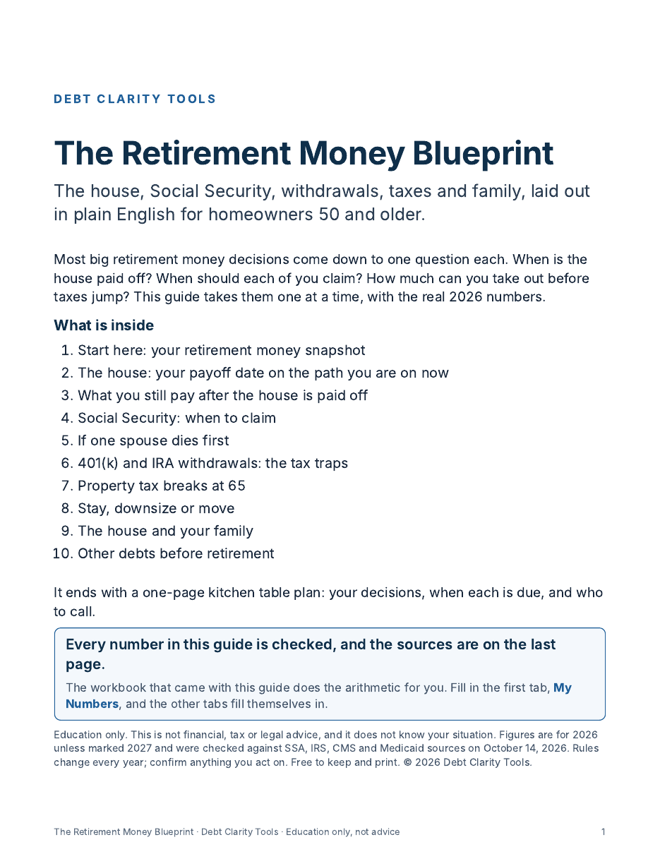
The Retirement Money Blueprint is a free 12-page guide and Excel workbook. List each debt once and see what the minimums cost you every month and which one to hit first, plus the month your mortgage ends.
For educational planning only, not financial advice.
How Extra Loan Payments Change Your Payoff Timeline
7
years cut from a 30-yr mortgage with $200/mo extra
Key Stat
Take a $300,000 mortgage at 6.66%, the 30-year fixed average in the Freddie Mac Primary Mortgage Market Survey for the week ending August 27, 2026. The scheduled payment is $1,927.88. Add $200 a month and the loan ends in month 276 instead of month 360: seven years earlier, and $107,568.20 less interest. The same rule holds on any installment loan, because a dollar of principal removed today stops earning the lender interest for every month that remains. Source: Freddie Mac PMMS.
Reviewed by Dr. James Frederick Smiling, PhD
Extra Payments Usually Go to Principal
Quick Answer
Most lenders apply extra payments directly to principal, the balance that interest is calculated on. Reducing principal faster means less interest accrues each month, which compounds the payoff acceleration over time. Always confirm your servicer's policy: some require a written instruction or specific payment code to ensure extra funds aren't held as a future scheduled payment instead.
Reviewed by Dr. James Frederick Smiling, PhD
In most standard installment loans, extra payments reduce the principal balance.
A lower principal means less interest can accrue moving forward, which can shorten the loan term.
Why Timing Matters
86%
of the first payment on a 30-yr 6.66% mortgage is interest
Key Stat
People assume the split starts near half and half. It does not. On that same $300,000 loan at 6.66%, the first payment is $1,927.88 and $1,665.00 of it is interest. Only $262.88 touches the balance. That is why an extra $200 sent in year one is worth far more than the same $200 sent in year twenty: early principal is the principal that still has the most months left to generate interest.
Reviewed by Dr. James Frederick Smiling, PhD
Paying extra earlier generally has a larger effect because it reduces the balance sooner.
Smaller balances earlier in the schedule often lead to less total interest over the life of the loan.
Important Details to Check with Your Lender
Quick Answer
Before making extra payments, confirm three things: your loan has no prepayment penalty, extra payments are applied to principal (not held as future payments), and the payment processes in the same billing cycle. Prepayment penalties are rare on modern mortgages but common on some auto and personal loans, a quick call to your servicer eliminates the guesswork.
Reviewed by Dr. James Frederick Smiling, PhD
Some loans have rules that affect extra payments, such as prepayment penalties, payment allocation policies,
or requirements to specify "apply to principal." Confirm how your lender applies extra payments before relying on a plan.
What Exactly Is an Extra Principal Payment?
Definition: extra principal payment
Money you send a lender above the scheduled monthly payment, with instructions to apply it to the principal balance. It is not an advance on next month's bill. It permanently removes that amount from the balance interest is charged on, which is why one $200 payment keeps saving you money every month for the rest of the loan.
Definition: amortization
The fixed schedule a lender builds when the loan is written, splitting each payment between interest and principal. Interest is charged first on the current balance, and only what is left over reduces principal. Early payments are mostly interest. Late payments are mostly principal. That order is the whole reason timing matters.
How Much Does Each Extra Dollar Actually Buy You?
Same $20,000 loan, same 7.14% rate, same 60-month term. Only the extra monthly amount changes. Notice the first $50 does the heaviest lifting per dollar.
Extra per month
Total monthly
Months to zero
Total interest
Interest saved
$0
$397.35
60
$3,840.78
baseline
$50
$447.35
53
$3,321.05
$519.73
$100
$497.35
47
$2,927.33
$913.45
$200
$597.35
38
$2,370.54
$1,470.24
$300
$697.35
32
$1,995.10
$1,845.68
Loan: $20,000 at 7.14% APR over 60 months. The 7.14% is the average 60-month new-car loan rate at commercial banks reported in the Federal Reserve's G.19 Consumer Credit release for the second quarter of 2026, published August 7, 2026. Interest compounded monthly, interest charged before the payment is applied, no new charges. Every figure recomputed against this page's own calculator engine on August 28, 2026.
Read the $50 row and the $300 row together. The first $50 a month buys 7 months and $519.73. Going from $200 to $300, another $100 a month, buys only 6 more months and $375.44 more. Extra payments have real diminishing returns, so if money is tight, the first small amount you can sustain is the one that matters most.
How Do I Make Sure the Extra Money Reduces Principal?
Five steps, about fifteen minutes. Four are one-time setup. The fifth is a thirty-second check on next month's statement.
Read the prepayment clause in your loan agreement. Search the PDF for "prepayment." Mortgages rarely carry a penalty. Some auto and personal loans do, and a few use a rebate method that quietly keeps part of the unearned interest.
Find the principal-only option in your servicer's portal. Most portals have one, often labeled "additional principal" or "principal reduction." If you cannot find it, call and ask directly rather than guessing.
Send the extra money as a separate transaction. A single combined payment is easier for a servicer to record as an advance on your next due date. A separate principal-only payment is much harder to misapply.
Automate it on the same day each month. Consistency is what produces the numbers in the table above. A skipped month does not just delay the savings, it removes them.
Check the next statement. Your balance should have dropped by the normal principal portion plus the full extra amount. If the statement instead shows your next due date pushed forward, call and ask for the payment to be reapplied to principal.
How much does an extra $100 per month save on a $15,000 loan at 9% APR?
On a $15,000 personal loan at 9% APR with a standard 60-month term, the scheduled monthly payment is $311.38. Adding $100 a month, so $411.38 in total, ends the loan in 43 months instead of 60 and saves $1,093.14 in interest. The savings compound because every early principal reduction lowers the base next month's interest is charged on. Double the balance and the shape changes: on $30,000 at the same 9% rate, that same $100 extra saves $1,288.79 but cuts only 10 months, because $100 is a much smaller share of a $622.75 payment. Run your own balance, rate and term in the calculator above.
Does my extra payment go to principal or interest first?
For installment loans, interest is calculated on the current outstanding balance before each payment is applied, meaning the interest portion is subtracted first, and whatever remains reduces principal. On a $15,000 loan at 9% APR, the first payment carries $112.50 in interest and $198.88 of principal; an extra payment beyond the required amount removes future interest on the principal it eliminates. Credit cards work differently, an extra payment reduces the revolving balance immediately and next month's interest is calculated on the lower balance. Both work in your favor; the mechanism just differs between loan types.
Do I need to tell my lender to apply extra payments to principal?
Yes, most lenders apply extra payments to your next scheduled payment, covering future interest first, rather than directly to principal unless you explicitly designate otherwise. To ensure your extra payment reduces the principal balance: write "apply to principal" in the memo field of a check, select the principal-only option in your lender's online portal, or contact customer service to confirm their process. Some lenders, particularly for mortgages and student loans, require a separate transaction or written instruction. Without that direction, what you intend as a principal reduction may simply advance your next due date rather than shortening your loan term.
Should I make monthly extra payments or save up for a lump sum?
Monthly wins, and by more than most people expect. Take the $15,000 loan at 9% APR over 60 months. Send $100 extra every month for a year and the loan closes in 43 months with $2,589.38 of interest. Save that same $100 in a drawer and hand the lender one $1,200 payment in month 12 instead, and the loan closes in 55 months with $3,193.40 of interest. Identical cash out of your pocket, $604.02 more interest and 12 more months of payments. The gap exists because each monthly payment starts shrinking the interest base immediately, while the money sitting in the drawer does nothing. Save the lump sum only when you are aiming at a specific milestone, like clearing a balance outright.
Does making extra payments on student loans work the same way?
Mechanically, yes. Extra principal payments on student loans reduce the balance and lower total interest, exactly as on any installment debt. The exception is federal loans on an income-based plan. As of July 1, 2026, the Department of Education replaced the old income-driven plans with the Repayment Assistance Plan, where the monthly payment is 1% to 10% of income and any remaining balance is discharged after 360 on-time payments. If you are on that track, or pursuing Public Service Loan Forgiveness, extra principal can shorten your path to zero but forfeit the forgiveness you were building toward. Confirm which plan you are actually on before sending extra money to a federal loan. Source: U.S. Department of Education, June 9, 2026.
Should I pay extra on my loan or put the money in a high-yield savings account?
This is a math question with a clean answer: compare your loan APR to the APY your bank is actually posting today, after tax. Paying down debt is a guaranteed, risk-free return equal to the loan rate. The Federal Reserve's G.19 release put the average 24-month personal loan at commercial banks at 11.86% in the second quarter of 2026, and no ordinary savings account is paying anywhere near that, so on a typical personal loan the payoff wins outright. The math flips on cheap debt: if you are carrying a 3.5% auto loan written in 2021, cash in a savings account paying more than 3.5% is genuinely worth more than the payoff, and it stays liquid. Look up your own posted APY rather than trusting a rate quoted in an article, because deposit rates move faster than published guides do.
How many months can I cut off my loan by adding $200 per month?
On a $20,000 auto loan at 7.14% APR over 60 months, the scheduled payment is $397.35. Adding $200 a month cuts the payoff from 60 months to 38, saving 22 months and $1,470.24 in interest. On a $25,000 personal loan at 10% APR over the same 60 months, where the scheduled payment is $531.18, that same $200 extra saves 19 months and $2,321.34. The month savings scale with balance and rate: the higher the rate and the larger the balance, the more work each extra dollar does, but the fewer months it buys. Use the calculator above with your own balance, rate and term.
Do biweekly payments really pay off a loan faster?
Yes, but for a plainer reason than the marketing suggests. Paying half your bill every two weeks means 26 half-payments a year, which is 13 full payments instead of 12. On a $20,000 loan at 7.14% APR over 60 months, that one extra payment works out to $33.11 a month, which finishes the loan in 55 months instead of 60 and saves $360.83 in interest. Real, but modest. Sending $200 extra a month on the same loan saves $1,470.24 and 22 months. The gain comes from the extra payment, not from the two-week rhythm, so if your servicer charges a setup fee to switch to biweekly, you are better off keeping monthly billing and adding the extra yourself.
Does paying off a personal loan early hurt your credit score?
Paying off a personal loan early may cause a small, short-lived dip in your credit score rather than real harm. A personal loan is an installment account, so closing it can slightly lower your credit mix and the average age of your accounts, often just a few points that bounce back within a few months. What you gain is bigger: you stop paying the remaining interest and free up your monthly payment. Check your loan agreement for any prepayment penalty first, then use the calculator above to see exactly how much interest an early payoff saves you.
100% free · no card
Every debt in one place
This calculator answers one question about one debt. The Retirement Money
Blueprint puts all of them on a single page: what you owe in total, what the
minimums are costing you every month, and which debt to hit first.
A PDF guide that shows you the order to pay in
An Excel workbook that does the arithmetic for you