
💳 Credit Card Payoff Calculator
A $6,000 balance at 23.79% takes 252 months and $10,786.65 in interest at the minimum payment. At $250 a month it takes 33 months and $2,225.48. This calculator shows your own numbers.
Enter your balance, APR and monthly payment to see your exact payoff date, total interest, and a full month-by-month amortization schedule. Then test an extra payment and watch the date move. No sign-up, and your figures never leave your browser. Last updated October 1, 2026.
Your Numbers
Enter balance, APR, and your monthly payment.
Assumes monthly compounding, no new charges, and one payment per month.
Graph
Your balance dropping to zero, month by month
Month-by-month payoff schedule
Desktop shows a table. Mobile shows stacked rows.
| Month | Starting balance | Interest | Payment | Ending balance |
|---|
Scroll to see all months. If your payment is too low to beat monthly interest, you'll see a warning instead of a payoff timeline.
Results
Your payoff summary updates after calculation.
Want to compare payoff strategies? Try the Snowball vs Avalanche Calculator.

Dr. James Frederick Smiling, PhD, Mathematics Education
These calculators were built by a university mathematics education professor who teaches statistics and financial literacy at the college level. He holds a PhD in Mathematics Education and has spent his career turning hard math into something everyday people can actually use.
As a husband and father of six, he has personally navigated student loans, credit card debt, and the rising cost of running a household, so these tools respect both the math and the real-life pressure behind it. No hype, no pressure, just the clear numbers most debt advice leaves out.
- ✓ PhD in Mathematics Education
- ✓ Teaches college statistics & financial literacy
- ✓ Standard amortization math, the method lenders use
- ✓ 100% free, we never store your numbers
How this calculator works: interest compounds monthly on your balance; your APR and payment stay fixed unless you change them; no new charges are added; results are estimates for planning, not financial advice.
What people are saying
Real, unprompted reviews, verified on Trustpilot.
"I wanted to see how fast I could pay off one of my credit cards. In about a minute it showed me exactly how many payments I had left and the date it would be paid off. It motivated me to put even more toward the card. So simple a third-grader could use it."
Dwight C.
"After searching for sites to help me understand and control my debt, this turned out to be the best one out there. It's simple to use and answers a lot of questions for free, and if you want a deeper plan, the guides are priced fairly. I'd gladly recommend it to anyone carrying real debt."
Richard B.
"The tools on this site helped me understand my personal finances better. I'd recommend them to anyone."
Alex J.
What Are Your Payoff Results Telling You?
Small extra payments can change the finish date more than you'd think.
-
Interest drag is front-loaded
Based on your inputs, much of your early payment goes toward interest. That's why progress may feel slow at first even when you're paying consistently. -
Minimum payments extend your timeline
Your results show how minimum payments keep balances active longer. Increasing your payment reduces future interest and shortens the payoff date displayed above. -
Why small increases matter
Micro-example: A $3,000 balance at 24% APR with a $95 payment can take years. Increasing the payment to $145/month can significantly shorten the timeline (varies). Your exact payoff and interest totals are shown above.
For educational planning only, not financial advice.
How Does Credit Card Payoff Actually Work?
Interest is charged on the balance first, and only what is left of your payment touches the principal. That order is why a balance moves so slowly at the start.
For scale: the Federal Reserve G.19 release puts the average rate on credit card accounts assessed interest at 22.15%, and the Federal Reserve Bank of New York reported $1.26 trillion in US credit card balances in its Q2 2026 Household Debt and Credit report. Source links are on the calculator methodology page.
Americans carried $1.26 trillion in credit card balances in the second quarter of 2026, per the Federal Reserve Bank of New York, at an average rate of 22.15% on accounts assessed interest. Understanding how interest compounds, and how your monthly payment amount changes your total cost, is the difference between paying off debt in 3 years or 10.
Reviewed by Dr. James Frederick Smiling, PhD
Why Does Credit Card Debt Feel Slow at First?
Credit card interest accrues daily and compounds monthly against your entire remaining balance. On a $5,000 balance at 20% APR, roughly $83 of your very first payment goes straight to interest, which is why balances barely move in the first few months even when you're paying consistently and on time.
Reviewed by Dr. James Frederick Smiling, PhD
Credit cards use revolving balances rather than fixed payoff schedules. Interest is applied repeatedly to the remaining balance, which means early payments often reduce interest more than principal. This can make progress feel slow even when payments are consistent.
Why Do Minimum Payments Keep a Balance Alive?
A $5,000 balance at 20% APR paid with minimum payments only takes 108 months to clear and costs $5,823 in interest, nearly double what you borrowed. Minimum payments are calculated as 1-3% of your balance, so as the balance shrinks, the payment shrinks too, extending payoff indefinitely.
Reviewed by Dr. James Frederick Smiling, PhD
Minimum payments are designed to keep accounts current, not to eliminate debt quickly. Because minimums are calculated as a small percentage of the balance, they often extend repayment over many years and increase total interest paid.
What Does This Calculator Show, and What Does It Not?
This calculator models payoff timelines using a fixed monthly payment, constant APR, and no new charges. It does not account for penalty APRs, balance transfer fees, or changes in spending behavior. Use it to compare payment scenarios and set a monthly target, then re-run it whenever your balance or payment amount changes.
Reviewed by Dr. James Frederick Smiling, PhD
This calculator estimates payoff timelines and interest based on fixed inputs. It does not account for new charges, fees, penalty APRs, or changes in spending behavior. Results are intended for planning and comparison purposes only.
Go deeper: What happens if you stop paying a credit card, How to pay off $10,000 in credit card debt, The true cost of minimum payments
What Is a Credit Card Amortization Schedule?
This tool also works as a credit card amortization schedule calculator. Along with your payoff date and total interest, it builds a month-by-month schedule showing your starting balance, the interest charged that month, your payment, how much goes to principal, and your new balance. That breakdown is what makes it clear why a balance barely moves at first, early on, most of each payment is interest, not principal.
To read your amortization schedule, look at the first few rows: the interest column is large and the principal column is small. As the balance falls, that flips, more of every payment starts reducing what you owe. Raising your monthly payment, or adding an extra amount, moves that turning point earlier and shrinks the total interest across the whole schedule.
What Do People Ask Most About Paying Off a Credit Card?
What does a credit card amortization schedule actually show you?
A credit card amortization schedule breaks your payoff into month-by-month rows showing exactly how much of each payment goes to interest, how much reduces your principal, and what your remaining balance is after each payment. In the early months, the interest portion dominates, on a $5,000 balance at 22% APR, roughly $92 of a $150 payment goes to interest and only $58 reduces what you owe. As your balance decreases, that ratio gradually shifts in your favor, more principal, less interest, which is why payoff progress accelerates toward the end. The schedule makes the invisible cost of credit card debt visible in a way that a single "total interest" number cannot.
How long will it take to pay off a $5,000 credit card balance at 22% APR?
At the current average credit card APR of 22% and a $150 monthly payment, a $5,000 balance takes approximately 52 months to pay off, just over 4 years, and costs about $2,798 in total interest. Increase that payment to $200 per month and the timeline drops to 34 months with about $1,750 in interest, saving roughly $1,050 and about a year and a half of payments. The relationship between payment amount and total interest is not linear: each additional dollar above the minimum removes multiple dollars in future interest charges because it reduces the balance on which interest compounds monthly. Run your specific balance and rate in the calculator above to see your exact payoff date.
How much of my minimum payment actually goes toward my balance?
On a $5,000 credit card balance at 22% APR, the minimum payment is typically around $100, and approximately $92 of that goes directly to interest, leaving only $8 to reduce what you actually owe. That near-total absorption by interest is why minimum-only payers watch their balance crawl downward for years despite never missing a payment. The minimum payment formula used by most card issuers, usually 1-2% of the balance or a flat $25-35, whichever is greater, is designed to keep your account in good standing, not to pay it off efficiently. Understanding this split is the single most important number to know before deciding how much to pay each month.
How much faster does an extra $50 per month get me out of credit card debt?
On a $5,000 balance at 22% APR with a $150 payment, adding just $50 more per month cuts the payoff from 52 months down to 34 months and saves approximately $1,050 in interest. That $50 per month has an outsized effect because it reduces principal faster, which lowers the balance on which interest is calculated every billing cycle. Even $25 extra per month on that same balance saves about 11 months and roughly $650 in interest. The math compounds in your favor: each dollar applied early eliminates future interest charges down the chain, making early extra payments far more powerful than late ones.
Why does my credit card balance barely go down even when I pay every month?
Credit card interest accrues daily on your outstanding balance, so by the time your payment posts, a portion of it is already spoken for before it touches your principal. At 22% APR, a $5,000 balance accrues roughly $3 in interest every single day, about $91 per month, which means a $100 minimum payment leaves only $9 actually reducing your debt. This is the compounding trap: as long as your payment barely exceeds the monthly interest charge, your balance decreases in single digits per cycle. The fix is paying enough above the minimum that a meaningful portion hits principal, even $50 extra per month changes the trajectory significantly.
Does paying more than the minimum improve my credit score?
Paying more than the minimum directly reduces your credit utilization ratio, the percentage of available credit you're using, which accounts for roughly 30% of your FICO score. A $5,000 balance on a $10,000 limit puts your utilization at 50%, which significantly suppresses your score; paying that down to $2,500 drops utilization to 25%, typically producing a measurable score increase within one to two billing cycles. Payment history, whether you pay on time, carries more weight at 35%, but utilization is the fastest-moving lever available to most cardholders. Consistently paying above the minimum accelerates both payoff and score recovery simultaneously.
Should I stop using my credit card while I'm paying it off?
Pausing new charges is the single most effective behavioral change in a credit card payoff plan, because every new purchase resets the amortization clock on that portion of the balance. If you're paying $200 per month toward a $5,000 balance but adding $150 in new charges monthly, you're only net-reducing the balance by $50, a pace that would take decades and cost thousands in interest. The practical approach is to freeze the card for the duration of the payoff period and redirect any essential recurring charges to a debit account or a card you pay in full each month. This is about not fighting the math in both directions at once, not about avoiding credit cards permanently.
Is this a free credit card interest calculator too?
Yes. Along with your payoff date, the calculator shows exactly how much total interest you'll pay at your APR, and how much interest you save by adding an extra monthly payment.
Can I use this calculator for multiple credit cards?
This calculator runs one card at a time, so enter each card separately to get its own payoff date and interest. A $5,000 card at 22% APR paid $150 a month, for example, clears in 52 months with about $2,798 in interest. To put every card into one plan and see which payoff order saves more, use the free Debt Snowball vs Avalanche calculator on Debt Clarity Tools.
100% free · no card
Every debt in one place
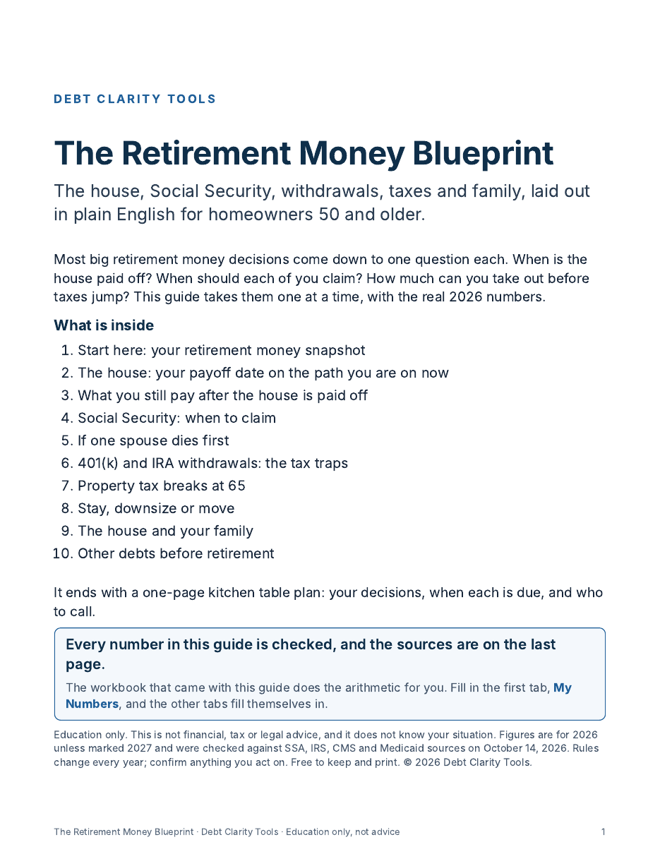
This calculator answers one question about one debt. The Retirement Money Blueprint puts all of them on a single page: what you owe in total, what the minimums are costing you every month, and which debt to hit first.
- A PDF guide that shows you the order to pay in
- An Excel workbook that does the arithmetic for you
- Auto-ranked quick wins from the numbers you type
Built by a mathematics education professor. Unsubscribe any time.