A $35,000 federal student loan at 6.52%, the 2026-27 undergraduate rate, costs $397.77 a month on the standard 10-year plan and $12,732.90 in interest.
Add $150 a month to that same loan and it finishes in 79 months with $8,108.24 in interest, a saving of $4,624.66. Put your own balance, rate and payment in below. The calculator returns your exact payoff date, your total interest to the dollar, and a month-by-month schedule, and it lets you test an extra payment against the same numbers.
Last updated August 28, 2026. Written and checked by Dr. James Frederick Smiling, PhD, Mathematics Education.
What Numbers Do I Need From My Servicer?
Three numbers off your servicer's dashboard: current balance, interest rate, and required monthly payment. Add an extra amount in the fourth box if you can send one.
Assumes monthly compounding and regular monthly payments.
What Does the Payoff Curve Show?
Your remaining balance plotted month by month. The line starts nearly flat because early payments are mostly interest, then drops faster as principal takes over.
Month-by-month payoff schedule
Desktop shows a table. Mobile shows stacked rows.
Month
Starting balance
Interest
Payment
Ending balance
Scroll to see all months.
When Will These Loans Actually Be Gone?
Four answers appear here after you calculate: months to zero, total interest, total repaid, and the calendar month your balance reaches zero.
Payoff time (months)
-
Total interest paid
-
Total amount paid
-
Estimated payoff date
-
Tip: Try $35,000 balance, 4.5% APR, $350 payment.
✓ Check your inbox, your plan is on the way.
Many recent graduates carry both student loans and credit card balances from college. If that is you, revisit the Credit Card Payoff Calculator.
Who built this & how it's calculated
Dr. James Frederick Smiling, PhD, Mathematics Education
These calculators were built by a university mathematics education professor who teaches statistics and financial literacy at the college level. He holds a PhD in Mathematics Education and has spent his career turning hard math into something everyday people can actually use.
As a husband and father of six, he has personally navigated student loans, credit card debt, and the rising cost of running a household, so these tools respect both the math and the real-life pressure behind it. No hype, no pressure, just the clear numbers most debt advice leaves out.
✓ PhD in Mathematics Education
✓ Teaches college statistics & financial literacy
✓ Standard amortization math, the method lenders use
✓ 100% free, we never store your numbers
How this calculator works: interest compounds monthly on your balance; your rate and payment stay fixed unless you change them; no new charges are added; results are estimates for planning, not financial advice.
"I wanted to see how fast I could pay off one of my credit cards. In about a minute it showed me exactly how many payments I had left and the date it would be paid off. It motivated me to put even more toward the card. So simple a third-grader could use it."
Dwight C.
★★★★★
"After searching for sites to help me understand and control my debt, this turned out to be the best one out there. It's simple to use and answers a lot of questions for free, and if you want a deeper plan, the guides are priced fairly. I'd gladly recommend it to anyone carrying real debt."
Richard B.
★★★★★
"The tools on this site helped me understand my personal finances better. I'd recommend them to anyone."
Alex J.
Your Student Loan Payoff Results, Timeline and Total Interest
Your payoff timeline is driven by your balance, interest rate, and how consistently you pay each month.
🎓 Student loans reward consistency
Based on your inputs, your plan works best when payments stay steady. Even small changes to your monthly payment can shift the payoff date over time.
💸 Extra payments usually reduce interest over time
Your results show how paying above the minimum can reduce the balance sooner, which lowers how much interest accrues moving forward.
📅 Do not ignore repayment details Micro-example: Different repayment plans, servicer rules, or interest capitalization can change the real outcome. Use the calculator as a planning baseline, your totals are shown above.
If you want a clear next step based on these results…
Put every debt on one page, free
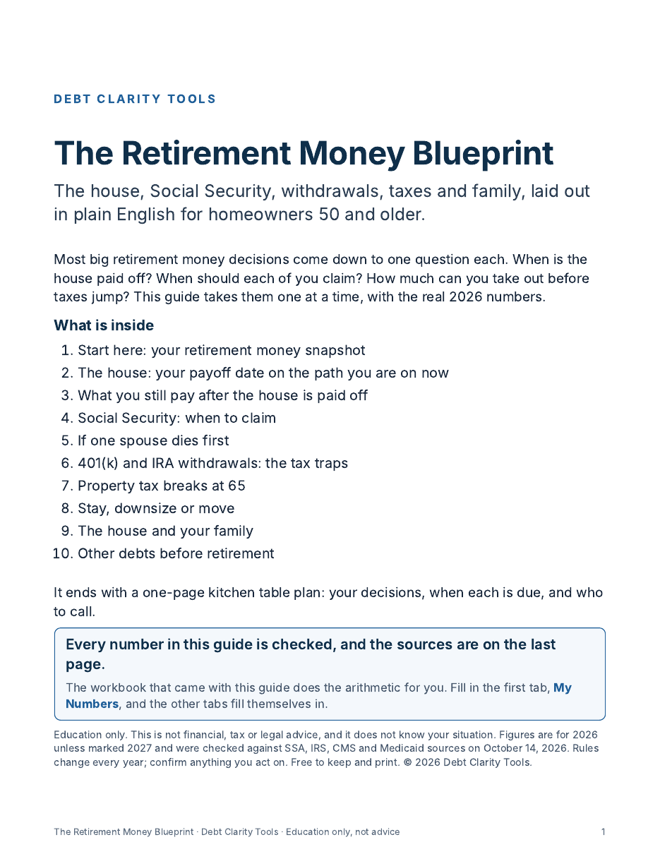
The Retirement Money Blueprint is a free 12-page guide and Excel workbook. List each debt once and see what the minimums cost you every month and which one to hit first, plus the month your mortgage ends.
For educational planning only, not financial advice.
How Student Loan Repayment Works (Plans, Interest, and Tradeoffs)
$1.86T
US student loan debt outstanding, June 2026
Key Stat
Student loans outstanding stood at $1,858.2 billion, about $1.86 trillion, in June 2026, according to the Federal Reserve's G.19 Consumer Credit release published August 7, 2026. The plan you repay under decides your monthly payment, your total interest, and whether any balance is ever discharged. Understanding how interest accrues and capitalizes turns a confusing system into a short list of decisions you can actually make. Source: Federal Reserve G.19.
Reviewed by Dr. James Frederick Smiling, PhD
Why Does My Student Loan Balance Feel Stuck?
Quick Answer
Student loans accrue interest daily on the outstanding balance. If your payment doesn't fully cover that daily interest, common with income-driven plans on large balances, unpaid interest capitalizes and gets added to your principal. The result: your balance grows even while you're making on-time payments, which is why some borrowers feel like they're making no progress at all.
Reviewed by Dr. James Frederick Smiling, PhD
Student loan interest accrues based on the outstanding principal and rate.
Early in repayment, a meaningful portion of each payment may go toward interest,
especially with higher balances or rates. This is normal and is why consistency matters.
Which Federal Repayment Plans Still Exist in 2026?
Quick Answer
The menu changed on July 1, 2026. The Department of Education retired the old income-driven plans and now offers two: the Repayment Assistance Plan, where the payment is 1% to 10% of income with any remaining balance discharged after 360 on-time payments, and the Tiered Standard plan, which sets a fixed term of 10, 15, 20 or 25 years based on how much you borrowed. Borrowers whose loans were made before July 1, 2026 and who sit in a phased-out plan have until July 1, 2028 to pick RAP, Tiered Standard, or Income-Based Repayment. Switching changes both your monthly payment and your total cost, often by tens of thousands of dollars. Source: U.S. Department of Education fact sheet, June 9, 2026.
Reviewed by Dr. James Frederick Smiling, PhD
Federal and private loans can follow different rules for interest, capitalization, and payment allocation.
Some repayment plans lower the required payment but extend the timeline.
Always confirm your plan terms and how extra payments are applied.
What to Track Month to Month
Quick Answer
Track three numbers each month: your outstanding principal balance, your accrued interest, and how your payment was allocated (interest vs. principal). If your balance is growing despite on-time payments, you're negatively amortizing, a clear signal to consider switching repayment plans or making a voluntary extra payment to stop the principal from compounding against you.
Reviewed by Dr. James Frederick Smiling, PhD
Track your payment amount, principal reduction, and any changes in rate or servicer policy.
A simple monthly check-in can keep you consistent and prevent surprises that slow progress.
What Do Capitalization and Negative Amortization Actually Mean?
Definition: capitalization
The moment a servicer takes the interest that has piled up unpaid and adds it to your principal. From that point on you are paying interest on that interest. It happens at set trigger events, such as leaving a deferment or dropping out of a repayment plan, not continuously.
Definition: negative amortization
When your required monthly payment is smaller than the interest accruing that month, so the balance goes up even though you paid on time. On a $50,000 balance at 6.52%, interest runs $271.67 a month. A $150 payment leaves $121.67 of interest unpaid, and that shortfall grows the balance.
What Does Each Repayment Choice Cost on $35,000?
Same $35,000 balance, same 6.52% rate. Only the plan and the payment change. Look at the total repaid column, not the monthly payment column.
Approach
Monthly
Months to zero
Total interest
Total repaid
Standard, 10 years
$397.77
120
$12,732.90
$47,732.90
Tiered Standard, 15 years
$305.27
180
$19,949.05
$54,949.05
Standard plus $150
$547.77
79
$8,108.24
$43,108.24
Standard plus $200
$597.77
71
$7,242.20
$42,242.20
Balance $35,000 at 6.52% APR. The 6.52% is the fixed rate on Direct Subsidized and Unsubsidized Loans for undergraduates first disbursed between July 1, 2026 and June 30, 2027, from Federal Student Aid announcement GENERAL-26-33. Interest compounded monthly, no capitalization events, no missed payments. Every figure recomputed against this page's own calculator engine on August 28, 2026.
The middle row is the one that catches people. Stretching to a 15-year term drops the monthly payment by $92.50, which is real relief when money is tight. It also costs $7,216.15 more in interest. That is not an argument against it. It is an argument for knowing the price before you sign, and for switching back to a shorter plan the moment your income allows.
How Do I Build a Student Loan Payoff Plan?
Five steps, about thirty minutes with your servicer dashboard open. You only build it once, then you check it twice a year.
Pull every loan from StudentAid.gov, not from memory. Most borrowers have several separate loans, one per year of school, each with its own fixed rate. The list on your dashboard is the real one.
Write down the balance and rate for each. If you have a 6.52% loan and an 8.07% loan, they are not interchangeable, and any extra money belongs on the 8.07% one first.
Run the total in the calculator above. Enter your combined balance, your highest rate as a conservative estimate, and your current required payment. That gives you your baseline payoff date and total interest.
Test one extra amount you could actually sustain. Not the number you wish you could send. The number that survives a slow month. Then compare the two payoff dates side by side.
Check your plan against the 2026 rules before you accelerate. If you are on the Repayment Assistance Plan or working toward Public Service Loan Forgiveness, extra principal can cost you more than it saves. If you are on a standard or tiered schedule, extra principal is pure gain.
Enter your loan balance, APR, and monthly payment into the calculator above. It returns your exact payoff date and total interest, and lets you add an extra monthly payment to see how many months you cut off.
Can this calculator handle multiple student loans at once?
Not in one pass. This calculator models one balance at one rate. Most borrowers graduate with several loans, one per year of school, each at a different fixed rate, so run them one at a time and add the results. If you want a single combined estimate, use your total balance with a weighted average rate: multiply each balance by its rate, add those products, and divide by the total balance. On $20,000 at 6.52% and $15,000 at 8.07%, the weighted rate is 7.18%. For a quick planning number that is close enough, but the loan-by-loan run is what tells you which balance deserves your extra payment.
How much total interest will I pay on $35,000 in student loans over 10 years?
On $35,000 in federal undergraduate loans at the 2026-27 rate of 6.52%, the standard 10-year plan means a monthly payment of $397.77 and $12,732.90 in total interest, so you repay $47,732.90 on a $35,000 loan. Raising the payment by $150 to $547.77 compresses the payoff from 120 months to 79 and cuts total interest to $8,108.24, a saving of $4,624.66. The interest is front-loaded: in year one, $2,206.19 of your payments go to interest and only $2,567.10 reduces the balance. That is exactly why extra money in years one through three does disproportionately more work than the same money in year eight.
How much faster can I pay off student loans with an extra $150 per month?
On a $35,000 balance at 6.52% APR under the standard 10-year plan, adding $150 a month drops the timeline from 120 months to 79, which is 3 years and 5 months sooner. Total interest falls from $12,732.90 to $8,108.24, a saving of $4,624.66. Even $75 extra a month on this loan saves $2,837.69 and pays it off 25 months early. The savings are large relative to the extra payment because each early principal reduction removes that balance from the interest base for every month that follows, so the effect stacks rather than adding up in a straight line.
What is the current federal student loan interest rate for 2026-2027?
For loans first disbursed between July 1, 2026 and June 30, 2027, the fixed rates are 6.52% on Direct Subsidized and Unsubsidized Loans for undergraduates, 8.07% on Direct Unsubsidized Loans for graduate and professional students, and 9.07% on Direct PLUS Loans for parents and graduate borrowers. Each is the high yield of the May 12, 2026 ten-year Treasury note auction, 4.468%, plus a statutory add-on of 2.05, 3.60 or 4.60 points. The rate resets every July 1 for new loans, but the rate on a loan you already hold is fixed for its life, so an older loan keeps its original rate. Source: Federal Student Aid, announcement GENERAL-26-33.
Why is my student loan balance not going down even though I'm making payments?
On the older income-driven plans the required payment was a percentage of discretionary income, not an amount sized to cover interest. When that payment fell short of the interest accruing, the difference was added back to principal and the balance grew despite on-time payments. That is negative amortization, and it was a structural feature, not a servicer error. On a $50,000 balance at 6.52% APR, interest accrues at $271.67 a month, so a $180 payment leaves a $91.67 shortfall that grows the balance every month. The Repayment Assistance Plan that took effect July 1, 2026 addresses this directly: it waives the remaining unpaid monthly interest when you pay on time, and adds a matching principal payment of up to $50 a month if your payment did not reduce principal by at least that much.
Does refinancing student loans make sense right now?
Refinancing federal loans into a private loan makes sense when you can get a rate meaningfully below your federal rate and you have no intention of using an income-based plan, a forgiveness program, or federal forbearance. Run the numbers before you decide. On a $40,000 balance over 10 years, an 8.07% graduate Direct Unsubsidized loan costs $486.79 a month and $18,414.94 in interest. Refinanced to 5.5% it costs $434.11 a month and $12,092.61, a saving of $6,322.33. That is real money. The trade is permanent and one-directional: you give up the Repayment Assistance Plan, Public Service Loan Forgiveness eligibility, and the ability to pause payments during hardship, and you cannot convert back. For a borrower with stable private-sector income and no forgiveness path, the math usually favors refinancing. For anyone whose income might drop, it usually does not.
Should I pay off student loans aggressively or enroll in the Repayment Assistance Plan?
Aggressive payoff wins when your balance is manageable next to your income and no forgiveness is realistically coming, because the interest savings are real and they compound. The Repayment Assistance Plan wins when your balance is large relative to your income, when you work in public service and qualify for Public Service Loan Forgiveness after 120 qualifying payments, or when your income is low enough right now that a standard payment would not be sustainable. A rough breakpoint is a balance-to-income ratio above 1.5. If you borrowed $60,000 and earn $40,000, the income-based route is likely the better structure. If you borrowed $25,000 and earn $65,000, aggressive payoff clears the debt faster than any discharge timeline, since RAP discharge only arrives after 360 on-time payments.
What is the Repayment Assistance Plan and how is it different?
The Repayment Assistance Plan, or RAP, took effect July 1, 2026 and replaced the older income-driven plans for new borrowers. Three things make it different. The payment is 1% to 10% of your income, reduced by $50 a month for each dependent. Unpaid monthly interest is waived when you pay on time, so the balance cannot grow the way it did under the old plans. And if your on-time payment does not reduce principal by at least $50, the Department adds a matching principal payment of up to $50. Any remaining balance is discharged after 360 on-time payments. If your loans were made before July 1, 2026 and you sit in a plan that is being phased out, you have until July 1, 2028 to choose between RAP, the Tiered Standard plan, and Income-Based Repayment. Source: U.S. Department of Education, June 9, 2026.
100% free · no card
Every debt in one place
This calculator answers one question about one debt. The Retirement Money
Blueprint puts all of them on a single page: what you owe in total, what the
minimums are costing you every month, and which debt to hit first.
A PDF guide that shows you the order to pay in
An Excel workbook that does the arithmetic for you