
Loan Payoff Calculator With Extra Payments
See how extra principal payment amounts change your payoff date and total interest. Try extra payments to pay off loan early and reduce total interest.
Your Loan
Enter principal, APR, term, and an optional extra monthly payment.
Assumes monthly compounding and one payment per month.
Graph
Here's a visual breakdown of your payoff timeline
Month-by-month payoff schedule
Desktop shows a table. Mobile shows stacked rows.
| Month | Starting balance | Interest | Payment | Ending balance |
|---|
Scroll to see all months.
Results
Your payoff summary updates after calculation.
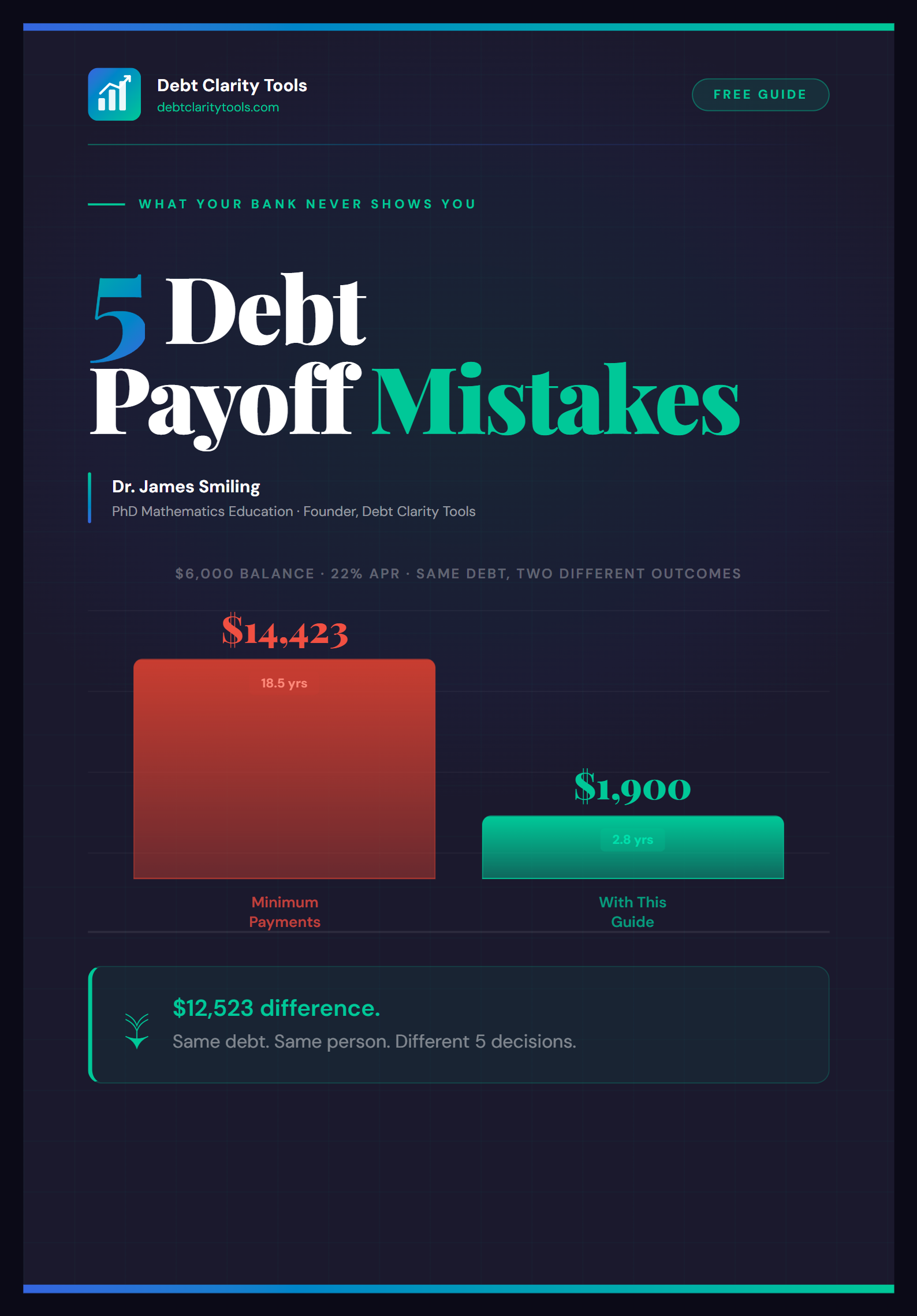
Extra Payments Are Smart — Unless You're Making Mistake #4.
Adding extra payments is one of the smartest moves you can make. But 4 out of 5 mistakes in this free guide can cancel out that progress without you realising it.
- The payment timing mistake that quietly reduces your extra payment's impact
- What to do before you add a single extra dollar
- Instant PDF download — no credit card required
Considering combining balances to simplify payments? Try the Debt Consolidation Calculator.
Your Loan Extra Payment Results — How Much Faster You Finish
Even small extra payments can change your payoff date more than most people expect.
-
🧾 Extra payments reduce principal first
Based on your inputs, extra payments go toward the loan balance. A lower balance means less interest can build up over time. -
📉 Interest savings grow over time
Your results reflect how paying extra earlier can reduce total interest paid. Consistency matters more than the size of any single extra payment. -
⏱️ Why your payoff date moves
Micro-example: Adding a small extra amount each month can shorten the schedule because you’re reducing the balance faster. Your estimated payoff time and totals are shown above.
If you want a clear next step based on these results…
Used your calculator? Get the action plan.
The Loan Extra Payment Plan
Your calculator showed what extra payments do. This plan shows you exactly how much to add, when to add it, and how to automate it so you never miss the savings.
- ✓ See exactly how many years one extra payment removes from your loan
- ✓ Find the minimum extra payment that creates maximum impact
- ✓ Learn how to apply extra payments correctly so they actually reduce principal
- ✓ Printable one-page action plan — your entire strategy on one sheet
For educational planning only — not financial advice.
How Extra Loan Payments Change Your Payoff Timeline
mortgage with $200/mo extra
An extra $200 per month on a 30-year mortgage at 7% cuts roughly 4–5 years off your payoff date and saves tens of thousands in interest. The math applies to any installment loan: every dollar of principal you remove early stops compounding interest for the remaining life of the loan.
Extra Payments Usually Go to Principal
Most lenders apply extra payments directly to principal—the balance that interest is calculated on. Reducing principal faster means less interest accrues each month, which compounds the payoff acceleration over time. Always confirm your servicer's policy: some require a written instruction or specific payment code to ensure extra funds aren't held as a future scheduled payment instead.
In most standard installment loans, extra payments reduce the principal balance. A lower principal means less interest can accrue moving forward, which can shorten the loan term.
Why Timing Matters
go to interest, not principal
In an amortizing loan, early payments are heavily interest-weighted—on a 7% mortgage, roughly half your first payment is pure interest. That's why extra payments made early in the loan save dramatically more than the same dollars paid later: you're cutting the principal that generates the most future interest charges.
Paying extra earlier generally has a larger effect because it reduces the balance sooner. Smaller balances earlier in the schedule often lead to less total interest over the life of the loan.
Important Details to Check with Your Lender
Before making extra payments, confirm three things: your loan has no prepayment penalty, extra payments are applied to principal (not held as future payments), and the payment processes in the same billing cycle. Prepayment penalties are rare on modern mortgages but common on some auto and personal loans—a quick call to your servicer eliminates the guesswork.
Some loans have rules that affect extra payments, such as prepayment penalties, payment allocation policies, or requirements to specify “apply to principal.” Confirm how your lender applies extra payments before relying on a plan.
Go deeper: How extra payments cut years off your loan — How to build a debt payoff plan in 30 minutes
Before you leave
Most people making extra payments are applying them wrong — and losing the savings.
The 10-minute Loan Extra Payment Plan shows you exactly how to apply extra payments so they actually cut years off your loan.
FAQ
How much does an extra $100 per month save on a $15,000 loan at 9% APR?
On a $15,000 personal loan at 9% APR with a standard 60-month term, the required monthly payment is approximately $311. Adding $100 per month — paying $411 total — reduces the payoff from 60 months to roughly 44 months and saves approximately $787 in interest. The savings compound because each early principal reduction lowers the base on which next month's interest is calculated. On a larger loan — $30,000 at the same rate — the same extra $100/month saves closer to $1,400 and cuts nearly 18 months off the timeline. Run your specific balance and rate in the calculator above to see your exact savings.
Does my extra payment go to principal or interest first?
For installment loans, interest is calculated on the current outstanding balance before each payment is applied — meaning the interest portion is subtracted first, and whatever remains reduces principal. On a $15,000 loan at 9% APR, the first payment carries roughly $112 in interest; an extra payment beyond the required amount removes future interest on the principal it eliminates. Credit cards work differently — an extra payment reduces the revolving balance immediately and next month's interest is calculated on the lower balance. Both work in your favor; the mechanism just differs between loan types.
Do I need to tell my lender to apply extra payments to principal?
Yes — most lenders apply extra payments to your next scheduled payment, covering future interest first, rather than directly to principal unless you explicitly designate otherwise. To ensure your extra payment reduces the principal balance: write "apply to principal" in the memo field of a check, select the principal-only option in your lender's online portal, or contact customer service to confirm their process. Some lenders — particularly for mortgages and student loans — require a separate transaction or written instruction. Without that direction, what you intend as a principal reduction may simply advance your next due date rather than shortening your loan term.
Should I make monthly extra payments or save up for a lump sum?
Monthly extra payments almost always outperform an equivalent lump sum paid later, because each monthly reduction lowers the balance on which interest accrues during the months you would have been saving. Paying an extra $100 per month for 12 months saves more in interest than a single $1,200 payment at month 12, because the earlier months of reduced balance generate earlier interest savings. The lump sum approach makes practical sense only when you're building toward a specific milestone — paying off a balance completely, or reaching a threshold that triggers a rate reduction — where the structural benefit outweighs the timing advantage of monthly payments.
Does making extra payments on student loans work the same way?
Mechanically, yes — extra principal payments on student loans reduce the balance and lower total interest, the same as any installment debt. However, if you're enrolled in an income-driven repayment plan or pursuing Public Service Loan Forgiveness, extra payments may not benefit you financially and could cost you money. Under income-driven plans, payments are based on discretionary income regardless of balance, and remaining balances can be forgiven after 20–25 years. In those programs, aggressively paying down principal shortens the timeline to zero but eliminates the forgiveness benefit you've been building toward. Confirm your repayment plan type before making extra principal payments on federal loans.
Should I pay extra on my loan or put the money in a high-yield savings account?
This is a math question with a clear answer: if your loan APR exceeds your savings account yield, pay down the loan — it's a guaranteed return. At current rates, high-yield savings accounts are offering approximately 4.5–5.0% APY, which means paying extra on a personal loan at 9–12% APR almost always wins — the guaranteed return of debt elimination beats a 4.75% yield on cash. The math flips for low-rate debt: if you have a 3.5% auto loan from 2021, there's a strong case for keeping money in a high-yield account earning more than your loan rate. Your loan APR is the benchmark — compare it directly to your best available yield.
How many months can I cut off my loan by adding $200 per month?
On a $20,000 auto loan at 7% APR with a 60-month term, adding $200 per month to the standard $396 payment cuts the payoff from 60 months to approximately 41 months — saving 19 months and roughly $1,200 in interest. On a $25,000 personal loan at 10% APR over 60 months, the same $200 extra saves 18 months and approximately $2,100. The month savings scale with loan size and rate: the higher the rate and the larger the balance, the more work each extra dollar does. Use the calculator above with your specific balance, rate, and term to see your exact month and interest savings.
You could save
$0
by paying extra.
Don't let these 5 mistakes quietly cancel out that progress before you even get started.
- ✓ The timing mistake that reduces your extra payment's impact
- ✓ What to confirm with your lender before paying extra
- ✓ What to fix before you add a single extra dollar
- ✓ Free 7-page PDF — no credit card, no account required